Showing posts with label Higher Education. Show all posts

Tuesday, October 16, 2012

Decision making for institutional construction projects

Decision making dynamics are clearly defined in theory, but continue to be a major challenge in practice. Awareness of typical pitfalls will be an essential step to successful project completion.

Universities and similar institutions tend to be organized in hierarchical systems. However, once a project is conceived, input from all layers of the organization may be sought and processed. While the president of an organization may reserve a "final say", architects have  to carefully analyze comments from students, janitorial and maintenance staff, donors, faculty and administration. Further, it is best practice to review state of the art solutions to similar projects, and discuss feasibility of implementing new practices that current user groups may not have been exposed to previously.
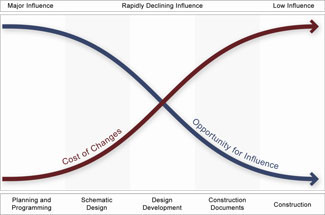
Budget constraints require creative compromises throughout the process. A textbook project will have most decisions set during the programming phase, since changes impact cost and schedule exponentially as the project progresses towards construction. As design develops every aspect of the project develops complex relationships with others parts. A mechanical unit that heats with gas is connected to civil, structural, spatial, and electrical requirements, each of which would be affected significantly if it was changed to an electrical heat unit later on.

Factors that lead to changes later in the project include actual changes of circumstance (e.g. funding) with direct effect on project scope; the common perception that "anything that isn't built yet can be easily changed"; executive levels that have special interest areas in the project, yet were not involved earlier based on time constraints; failure to communicate rationale leading to design compromises; and failure to foresee related changes when discussing "value engineering options".

While it is the architect's responsibility to guide all team members through the process, client awareness of these factors early on can be the ultimate key to a successful project.

Provided by Spark Architecture


Wednesday, September 19, 2012

Class staging, informal work and communication areas

Where are students before and after class? New teaching environments look at those transition times as windows of opportunity, and strive to offer opportunities for student-faculty and student-student interaction, as well as personal study. Academic and social interaction play important roles, thus a variety of spaces should be offered.

Hallways adjacent to classrooms can be equipped with individual study furniture, and readily accessible power. Alcoves, carpets and acoustical ceilings create a quiet atmosphere.

Strategically located lounge areas serve small groups as meeting and group study areas, and house vending equipment.

Small group study rooms, acoustically separated from open circulation, complete the range of study areas.

Great examples for classroom buildings with a variety of staging areas are Chandler Gilbert Community College (CCGC) Ironwood Hall and Surprise "Communiversity" by Architekton.


Provided by Spark Architecture

Tuesday, September 11, 2012

Paradigms of today's college classrooms.

While a basic specification of a classroom still includes maximum occupancy counts and available technology, teaching and learning methods have moved away from a strict lectern to audience monologue.

Presenters, whether teacher or student, move around the room, pointing at projections on different surfaces, and addressing different groups. With an increased focus on collaboration, student seating rearranges fluently in the course of a single lecture, starting out in traditional classroom layout, breaking out into work groups, and returning to a classroom setting to present their groups results. Individual groups may have dedicated whiteboards-projection surfaces at their disposal. Students or groups can submit questions and input through their tablets. (Ipad and similar). From here, it is only a small step to link off-site students to participate in the same class.

A common mistake is to block all daylight in an attempt to facilitate better projection. While glare has to be carefully controlled by window placement, size, blinds, or switchable skylights, daylight greatly contributes to student alertness. Further, projection technology has improved to function in much brighter settings.


Resources:

Steelcase has developed a number of integrated product solutions for today's Education market ranging from chairs to mulch-media collaboration. http://www.steelcase.com/en/products/category/educational/research/pages/research.aspx

node with worksurface


Solatube has developed switchable skylights, that can be dimmed to accommodate a variety of light levels. While Skylights have the potential to greatly enhance lighting quality and reduce long term energy costs, first cost remains a challenge. Code requires to provide sufficient artificial lighting, which makes skylights a common value engineering target.      http://www.solatube.com/commercial/daylighting/index.php


www.Spark-Architecture.com