Showing posts with label Spark Architecture. Show all posts

Tuesday, August 2, 2016

We're hiring. Please write your own job description:

After four years Spark Architecture is getting more and more work, and needs your help. We've moved from the occasional bigger education project, and many odds-and-ends projects into the residential market. Not the millionaire's and starter-castle segment, but the +/- $200k market. Instead of frowning and mourning the quality or non-existance of those new homes, we're dedicating ourselves to the challenge of doing a better job. What a learning curve! Can it be done? Good design has many faces, some obvious from pretty pictures, others more hidden such as many sustainability driven design strategies, or the overall impact on a given neighborhood.
We have a couple townhouse neighborhoods on our boards, as well as a few single family residential projects.  A couple potential multifamily developments are on the horizon. And we need your help to make these projects the very best they can be.

How to write your own job description:
(switching into first person singular here, Sophia speaking)

I've seen incredible talent go to waste by folks being pushed to do things they really did not care about, or to work under logistically not so great circumstances. You've probably met them:
  • The amazing Designer promoted to be project manager and stuck in endless meetings. The  introverted Geek expected to attend public functions as the face of the firm.
  • The talented young graduate or intern pigeon-holed into cheap labor tasks instead of tapping into his skills.
  • The experienced guy retiring because he's tired of PM BS instead of mentoring and sharing his experience with the new kids.
  • The burnt-out newly (or almost) licensed kid that quits architecture and lives on an organic farm instead (of course that's cool too!). 
  • The woman that quits to have a family, or doesn't have a family because her career seems too demanding.
I want to create the opportunity to align your skills and lifestyle preferences with your work. What those skills are, and whether that means working part time or from home,  incorporating sabbaticals, only you can say.

I'm confident that we can find great use for your talent, whether you're a design-, accountant-, PR-, PM-, graphics-, code-, Revit-, lighting-, landscape-, detailer-,  interiors-, construction-, visualization-, financial-, specifications-, legal-, or you-name-it sage (or aspiring sage).

Company Culture:
Spark Architecture is just starting to grow, so you will make a big impact on what our culture may become. A few things that are likely to stick around:
  • Don't panic. I'm the kid that had to move out of studio because all the frantic panic and all-nighter heroism just made me unable to focus. A little stress here and there is good and part of our profession, but weekends and nights should be an exception to the rule instead of gold star points. No martyr mentality encouraged here. // If you've read this far you won't be surprised that I'm also a mother of two little ones, and a Yoga teacher for fun//
  • Blame everyone else. Just kidding! I have a real hard time with folks that constantly complain about their circumstances or others behind their back, point fingers, or blame others. At the same time I encourage positive confrontation, which means a culture where questioning proposed designs, office culture, habits, and solutions is a good thing, and your annoyance with me or anyone else is voiced right away before it can build up into a stomach ache. Read Barbara Pachter if you're curious on how to do that, I had to learn it too.
  • Live. Seriously. No count-down to retirement. It will be a challenge to put this into practice, but I get really excited about creating an opportunity to live a good life, whatever that means for you. I love Patagonias company culture - go surfing (fishing) when the fishing is good, and work the rest of the day. Initially we may not be able to offer high salaries, but we can offer flexibility. As we grow benefits and salaries should come along. 

Great Falls:
If you already live here I hope you share my appreciation for this place, and what it might become. I grew up in Europe, traveled the world, and spent a decade in the 6+M Phoenix Metro Area. I still enjoy traveling and visiting those places, but Great Falls is a great place to live. You can afford to buy a historic building downtown, or acres for a hobby farm a few miles out of town. We have great schools. Great Falls is just starting to wake up, and you/we can be part of it. We still need more bike and pedestrian friendly areas, and I'm waiting for a few more good dining choices, but things are happening. Yes, it gets windy, but we also get lots of sunshine and blue skies. Did I mention the truly un-crowded mountains, lakes, and rivers nearby?

If you're not ready to make the move to Great Falls, but live in Montana we can try a remote-work arrangement. We have one person out of state, but that is currently limited to "unsupervised" contractor/consultant relationships.

Send me a note:
Any suggestions, ideas, and interest in working or collaborating? It could be a summer internship, a part time job, a mentorship in either direction, or a path to ownership. When you first reach out feel free to include links to your work, but don't include file attachments. I look forward to hearing from you! Sophia@Spark-Architecture.com

Cheers,
Sophia


Friday, January 25, 2013

Is Great Falls a good place to open a restaurant?

You may not be interested in running a restaurant, but found yourself saying "I wish we had a (fill in the blank) restaurant". Both individually owned local restaurants and chain restaurants have to feel confident about profitability within a local market. In 2012 Great Falls ranked #246 nationally, 12.44 points above average.
Source: http://www.monkeydish.com/towns-with-potential/home; captured 1/25/2013
In other words, if you wondered why national chain X isn't here yet, they have 245 other cities to go first. Amongst them are Missoula, Bozeman, Billings (which just saw a series of restaurants open), and Kalispell. Of course those chains have additional criteria such as special markets, available sites, traffic counts, and available liquor licenses.

The good news for local restaurants is that we still have 12.44 points of "untapped" potential. If our economy grows, we will see our ranking improve. If more restaurants come onto the market, it may drop, unless we start tapping into the Glacier-Yellowstone tourist flow, and increase local demand dramatically.

How do they come up with those ratings? The Journal "Restaurant Business" explains it in their April 2012 edition. In a few words, our local average income, existing number of restaurants, and population are compared to US averages. One-hundred is average, and the higher above 100 the more promising the market is to new restaurants.

Curious about the best towns to open up shop? Corbin, KY (the origin of KFC), and Key West, FL are top contenders! Go to http://www.monkeydish.com/ for more information.

"Restaurant Business" Journal, April 2012, p.22


Provided by Spark Architecture

Thursday, January 24, 2013

Downtown Great Falls Master Plan

Following up on some of your comments on Facebook , I'd like to share some thoughts on Master plans, and reference specific information about our current Downtown Master Plan, adopted October 2011.
The current Great Falls Masterplan can be downloaded at: http://www.greatfallsmt.net/sites/default/files/archives/records/minutes/yr2011/DTMP.pdf

Master plans are a great way to build general guidelines, and incorporate comments from (extensive) public meetings into one handy document. The goals for our current Master plan could be paraphrased as a connected, flourishing Downtown, that serves as a local destination, offers more residential options, and improved aesthetics. Each of those goals has a set of objectives and implementation outlines, and yes, "Complete Streets" is mentioned more than once. It also lists a number of strategies to bring more life Downtown on evenings and weekends.

When new projects are proposed to the City, folks on the Planning Board, Commission, and City staff review them for general compliance with the plan. While additional public comment is usually required and encouraged, it allows the City to approve compliant projects with relative ease.

That being said, given limited public funds, any master plan heavily depends on residents, developers, and other organizations to bring it to life. Recognizing this, the current plan suggested the formation of a Downtown Developing Board including a variety of community stakeholders and groups. Late 2012 the "Downtown Partnership" was formed,  hopefully channeling the energy and initiatives into more actual progress.

If you are interested in long term planning for Great Falls (beyond downtown), make sure to follow the growth policy update and events. Throughout 2012 the City has received ample citizen participation in formulating the new growth policy, which will guide Great Falls' long term direction and planning decisions.


Provided by Spark Architecture


Wednesday, January 23, 2013

Great Falls - Historic Walking Tours

We pass these buildings many times, wondering what stories they hold. Next time you're downtown, on River Edge Trail, or the Railroad district, check out one of the historic walking trail brochures:

"The Central Business Historic District Walking Tour Brochure presents a sampling of the history and architecture of downtown Great Falls and celebrates a collaboration of business, tourism, history and the arts.  Ninety-nine buildings contribute to the history of the district, which was listed in the National Register of Historic Places in 2004."

"The River’s Edge History Tour provides a look at the pre-history and historical resources along the Missouri River corridor.  The approximately five mile section of the river will take about two hours if you are walking the River’s Edge Trail for the entire distance.  There are numerous access points along trail, and the Lewis & Clark Interpretive Center, the Fish Wildlife & Parks Visitor Center and Giant Springs State Park also offer parking and other public facilities.  The history tour is great companion piece for the River’s Edge Trail Map."


 "In 1993, the Great Falls Railroad Historic District was listed in the National Register of Historic Places, the official list of the nation’s resources considered worthy of preservation.  This brochure provides a stroll through the district that once served the bustling railroad freight and passenger business in Great Falls and Gibson Park, the city’s premier park."


 Excerpts from The City of Great Falls Historic Preservation Office website.


Spark Architecture

Grants (a.k.a. money) for your ideas

Always wanted to build a playground, school garden, add to your neighborhood park, or library? The MSU extension office painstakingly lists  available grant programs. If you don't have a project in mind yet, check out available grants for ideas.

Intimidated by "grant writing"? There is no magic to it, and you don't need a special degree, just a good dose of enthusiasm. A lot of grants are easy online forms. For others, shoot us a comment with your ideas, and we'll connect you with community resources to help.

At the time of this writing the list contained close to 200 available grants. Below are just a few fun grants with upcoming due dates:


Jamba Juice (due 2/18): http://grants.kidsgardening.org/its-all-about-fruit-and-veggies

Grow Your Park (due 2/6): http://www.nrpa.org/garden/

Do something (Seeds and other grants, weekly): http://www.dosomething.org/grants/seed-grants


Enjoy, and start doing something :)


Spark Architecture

Tuesday, October 16, 2012

Decision making for institutional construction projects

Decision making dynamics are clearly defined in theory, but continue to be a major challenge in practice. Awareness of typical pitfalls will be an essential step to successful project completion.

Universities and similar institutions tend to be organized in hierarchical systems. However, once a project is conceived, input from all layers of the organization may be sought and processed. While the president of an organization may reserve a "final say", architects have  to carefully analyze comments from students, janitorial and maintenance staff, donors, faculty and administration. Further, it is best practice to review state of the art solutions to similar projects, and discuss feasibility of implementing new practices that current user groups may not have been exposed to previously.

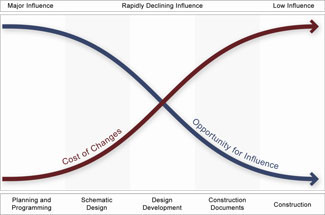
Budget constraints require creative compromises throughout the process. A textbook project will have most decisions set during the programming phase, since changes impact cost and schedule exponentially as the project progresses towards construction. As design develops every aspect of the project develops complex relationships with others parts. A mechanical unit that heats with gas is connected to civil, structural, spatial, and electrical requirements, each of which would be affected significantly if it was changed to an electrical heat unit later on.

Factors that lead to changes later in the project include actual changes of circumstance (e.g. funding) with direct effect on project scope; the common perception that "anything that isn't built yet can be easily changed"; executive levels that have special interest areas in the project, yet were not involved earlier based on time constraints; failure to communicate rationale leading to design compromises; and failure to foresee related changes when discussing "value engineering options".

While it is the architect's responsibility to guide all team members through the process, client awareness of these factors early on can be the ultimate key to a successful project.

Provided by Spark Architecture


Tuesday, September 11, 2012

Paradigms of today's college classrooms.

While a basic specification of a classroom still includes maximum occupancy counts and available technology, teaching and learning methods have moved away from a strict lectern to audience monologue.

Presenters, whether teacher or student, move around the room, pointing at projections on different surfaces, and addressing different groups. With an increased focus on collaboration, student seating rearranges fluently in the course of a single lecture, starting out in traditional classroom layout, breaking out into work groups, and returning to a classroom setting to present their groups results. Individual groups may have dedicated whiteboards-projection surfaces at their disposal. Students or groups can submit questions and input through their tablets. (Ipad and similar). From here, it is only a small step to link off-site students to participate in the same class.

A common mistake is to block all daylight in an attempt to facilitate better projection. While glare has to be carefully controlled by window placement, size, blinds, or switchable skylights, daylight greatly contributes to student alertness. Further, projection technology has improved to function in much brighter settings.


Resources:

Steelcase has developed a number of integrated product solutions for today's Education market ranging from chairs to mulch-media collaboration. http://www.steelcase.com/en/products/category/educational/research/pages/research.aspx

node with worksurface


Solatube has developed switchable skylights, that can be dimmed to accommodate a variety of light levels. While Skylights have the potential to greatly enhance lighting quality and reduce long term energy costs, first cost remains a challenge. Code requires to provide sufficient artificial lighting, which makes skylights a common value engineering target.      http://www.solatube.com/commercial/daylighting/index.php


www.Spark-Architecture.com