Friday, November 30, 2012

Finding Synergies in Historic Downtown Development

Earlier this week I visited Randy Hafer with High Plains Architects  in Billings to discuss opportunities to encourage additional Historic Development Downtown. Randy could be called the Guru of Montana historic tax credit projects. Having completed over six certified Historic Tax Credit Rehabilitation projects in Billings alone, he has also been instrumental in  recent Great Falls feasibility studies. Randy is the architect for recent local projects including the Arvon Block development and the Rocky Mountain Building.

Randy stressed the point of "synergy". A successful redevelopment project needs partners to compliment each others assets. Depending on the project, that could include a motivated owner, one or more investors, knowledgeable development, accounting, design, and legal support, as well as a supportive community. Depending on the intended use, one or more businesses can be important drivers of the development's success. Randy stressed how residential space has been the most successful use in projects so far, but mentioned that one of his partners has been driving development by implementing dining opportunities in first floor spaces.

The map below shows a recent inventory of historic potential in our own downtown. Spark Architecture is currently organizing a "historic development opportunities" Open House on Feb. 1st 2013. The goal for that night is opening the doors to synergies between businesses, building owners, and potential investors, as well as providing basic information on the "How-to". 


Tuesday, November 20, 2012

Great Falls, Montana Restaurant Makeover?

Instead of trying to import more great dining options, how about focusing on helping our local restaurants to become that great option?

The idea is not new, and TV shows like "Restaurant Impossible" by Food Network, and Fox "Kitchen Nightmares" suggest a trend. The Great Falls tribune already prominently features successful local "Ugly Bathroom Makeovers".

Google Plus rates restaurants with equal points for service, quality, and atmosphere. As laid out in previous posts, social Media and cellphone based cameras enable dining customers to share their experience with the world.  Similar to the TV series and local bathroom makeovers, a team of local businesses and organization could form a strike force, including marketing, design, building, and management assistance. Carefully documented into case studies, these projects could provide similar businesses (and their banks) with information and inspiration to decide on their own next moves.

Which local restaurant business do you nominate for a "makeover"?

Spark Architecture

Tuesday, October 16, 2012

Decision making for institutional construction projects

Decision making dynamics are clearly defined in theory, but continue to be a major challenge in practice. Awareness of typical pitfalls will be an essential step to successful project completion.

Universities and similar institutions tend to be organized in hierarchical systems. However, once a project is conceived, input from all layers of the organization may be sought and processed. While the president of an organization may reserve a "final say", architects have  to carefully analyze comments from students, janitorial and maintenance staff, donors, faculty and administration. Further, it is best practice to review state of the art solutions to similar projects, and discuss feasibility of implementing new practices that current user groups may not have been exposed to previously.

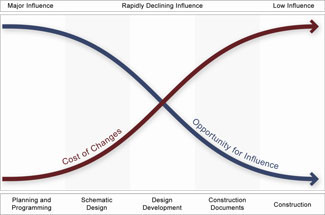
Budget constraints require creative compromises throughout the process. A textbook project will have most decisions set during the programming phase, since changes impact cost and schedule exponentially as the project progresses towards construction. As design develops every aspect of the project develops complex relationships with others parts. A mechanical unit that heats with gas is connected to civil, structural, spatial, and electrical requirements, each of which would be affected significantly if it was changed to an electrical heat unit later on.

Factors that lead to changes later in the project include actual changes of circumstance (e.g. funding) with direct effect on project scope; the common perception that "anything that isn't built yet can be easily changed"; executive levels that have special interest areas in the project, yet were not involved earlier based on time constraints; failure to communicate rationale leading to design compromises; and failure to foresee related changes when discussing "value engineering options".

While it is the architect's responsibility to guide all team members through the process, client awareness of these factors early on can be the ultimate key to a successful project.

Provided by Spark Architecture


It smells... delicious: Applied Phenomenology

Architects study objective and subjective aspects of the built environment. Objective subjects are easily observed and quantified. A bridge structure collapses when subjected to a certain amount of load. Phenomenology is a philosophical approach to more subtle qualities of our surroundings, and has been adopted by architects as a useful framework. It acknowledges that we experience our environment with all senses, and explores conscious and subconscious reactions to various inputs. We may have strong reactions to a place that subconsciously triggers certain associations.

The sense of smell can transport us back to long forgotten memories. It is directly connected with the sense of taste, and it comes to no surprise that it should be of special concern when designing a dining facility.

Fresh bread comes out of the oven at Model Bakery,  Oxbow CA Public Market.

First impressions when approaching the front door of a restaurant are affected by smells reaching from old liquor, burnt fryer oil, chlorine bleach, artificial air freshener, or neutral, to subtle smells of wood, caramelizing onions, baked apple, fresh baked bread, roasted garlic, and fresh croutons  fried in butter.  Careful planning of food preparation locations, as well as air supply and exhaust systems make a big difference. Conscious distribution of "smells" during opening hours such as serving baskets of fresh bread, accompanied by some herbed butter can make all the difference.


Provided by Spark Architecture

Thursday, October 11, 2012

Historic and Economic Development Resources, Great Falls and Montana

We are constantly on the lookout for local, regional, and national resources available to our community. Take a peak at our recent historic building blog post to learn about available resources for community projects. Not all require "historic" status. Please let us know if you know of additional organizations, so we can update the list accordingly.

Thank You!


Historic and Economic Development Resources, Great Falls and Montana

As promised  in our historic tax credit summary,  additional resources are listed below. Please let us know if you are aware of additional resources.

Great Falls Business Improvement (BID) District Grants 


BID grants are available for improvements within the BID district and are funded by a property tax improvement fund (TIF) to support downtown goals. They are unique in that they are available to owners or tenants. Grants cover a percentage of permanent improvements and contract labor costs. Separate grants are available for facade (up to 20%), interiors, and residential (up to 10%). Interiors for new businesses locating within the BID may qualify for up to 30% rebates. These grants are not limited to historic register projects, and may include new construction. Residential projects can be tenant or owner occupied. Property owners must be current on their property taxes to qualify. Recent examples include Taco del Sol, Murphy McClay, subway Building, and Lofts at Johnson Hotel.


Historic Tax Abatement:
The Montana Department of Revenue provides various development incentives, including a provision for development within historic districts. Properties within historic districts can qualify for an abatement of 100% of the taxable value increase attributed to the rehabilitation, restoration, expansion or new construction for a period of up to five years. A recently approved example is the Baum Trinastich Building (a.k.a. Owl Cigar Buidling) at 114 3rd St. S.  For more information contact Great Falls Historic Preservation Officer Ellen Sievert at 455-8435.

Great Falls Development Authority 
Great local business and development organization, supporting small business and attracting large investors. Assistance in finding loans and funding, such as through:

Montana Community Development Corporation
Resource in utilizing "New Market" tax credits for medium to big projects. New construction and existing building projects. 

Tourism Infrastructure Investment Program (TIIP)
The purpose of  (TIIP) is to provide grant funding that leverages other private and public funds for construction of new tourism-related facilities, and the enhancement of existing facilities to encourage visitors to stay in Montana longer and spend more money. The facility construction and enhancement will strengthen Montana’s attraction as a visitor destination. Funding starts at $20,000, with a phenomenal investment ratio of 1:2. Applicant status has to be non-profit. Submission deadline is end of July. Historic value is recognized amongst the selection criteria. In Great Falls restorations and renovation projects such as the Ursuline Center, the Iceplex have been awarded in the past two years. Other statewide projects include museums, parks, pavilions, event centers, and theatre renovations.

National Trust for Preservation
Non profit members of the National Trust Forum or Main Street; Funds have to be matched 1:1, and can generally only be applied to consulting and planning fees, not to construction itself.

Montana Economic Developers Association
Montana wide economic development seminars. Scholarships for industry professional development. 

EPA Brownfield Program

Launched in 1993, the program has provided 2,500 grants totaling $600M in direct funding to turn physical liabilities into community assets to date.  The EPA describes sample brownfields as "an abandoned factory, a boarded up corner gas station, a run down mill. In communities across the country, we see brownfields of every shape and size. It is hard to miss the graffiti-laced walls, the broken windows, the caved in roofs. It is equally hard to dismiss the unknown environmental contaminants and health hazards brownfields can pose." (...)

Community Reinvestment Fund 
Private non-profit organization issuing loans to qualified "socially beneficial" projects.


USDA Rural Development Grants and loans
Funds for rural businesses, communities, planning, local food systems, agriculture, and low income housing repair.

Government Grant search
Searchable database with information about all government grants.


Provided by Spark Architecture

Wednesday, October 10, 2012

Tax credits for historic buidings in Montana

IRS, National Parks, and State Historic Preservation office (SHPO) collaborate in the administration of federal historic tax credits. Current offerings include a federal tax credit of 20%  for non-owner-occupied historic buildings with rehabilitation costs greater $5,000, and a 10 % tax credit for non-residential, and non-historic structures built prior to 1935.

The State of Montana recognizes federal project legibility and currently offers additional 5% for a total of 25% of tax credits. No additional application is required, the state 5% can be directly deducted on state tax returns.

To be considered for the 20% credit, structures should be located in, and contribute to a historic district, which is assessed by the State Historic Preservation office. In addition to urban historic districts, rural districts offer interesting incentives for historic barn renovation for commercial or agricultural use.

If only a portion of the historic building is owner occupied, the remainder may still qualify for the tax credit.

Current Historic districts (HD) in Great Falls, Montana include in order for most recently listed:


  • Great Falls West Bank HD (300 and 400 Blocks, 3rd St NW). Listed 2010
  • Great Falls Central Business HD (Second Ave. N, First Ave. N, Central Ave., First Ave S.). Listed 2004
  • Great Falls Railroad HD ( Park and River Drs., 100-400 blks. 2nd St. S., 100-200 blks 1st and 2nd Aves S., and 100--300 blks. 3rd St. S.) . Listed 1993
  • Great Falls Northside Residential Historic District  (200-900 blocks 4th Ave. N., 100-900 blocks 3rd Ave. N., and 500-900 blocks 2nd Ave. N.). Listed 1991
  • Northern Montana State Fairground Historic District (3rd St NW). Listed 1989

Eligible projects have to comply with national rehabilitation standards and guidelines to preserve essential historic characteristics.


In addition, tax incentives for local development, state funds, and environmentally sound construction, as well as special loan conditions are available. Each of these will be discussed in separate posts.


www.spark-architecture.com