Tuesday, August 2, 2016

We're hiring. Please write your own job description:

After four years Spark Architecture is getting more and more work, and needs your help. We've moved from the occasional bigger education project, and many odds-and-ends projects into the residential market. Not the millionaire's and starter-castle segment, but the +/- $200k market. Instead of frowning and mourning the quality or non-existance of those new homes, we're dedicating ourselves to the challenge of doing a better job. What a learning curve! Can it be done? Good design has many faces, some obvious from pretty pictures, others more hidden such as many sustainability driven design strategies, or the overall impact on a given neighborhood.
We have a couple townhouse neighborhoods on our boards, as well as a few single family residential projects.  A couple potential multifamily developments are on the horizon. And we need your help to make these projects the very best they can be.

How to write your own job description:
(switching into first person singular here, Sophia speaking)

I've seen incredible talent go to waste by folks being pushed to do things they really did not care about, or to work under logistically not so great circumstances. You've probably met them:
  • The amazing Designer promoted to be project manager and stuck in endless meetings. The  introverted Geek expected to attend public functions as the face of the firm.
  • The talented young graduate or intern pigeon-holed into cheap labor tasks instead of tapping into his skills.
  • The experienced guy retiring because he's tired of PM BS instead of mentoring and sharing his experience with the new kids.
  • The burnt-out newly (or almost) licensed kid that quits architecture and lives on an organic farm instead (of course that's cool too!). 
  • The woman that quits to have a family, or doesn't have a family because her career seems too demanding.
I want to create the opportunity to align your skills and lifestyle preferences with your work. What those skills are, and whether that means working part time or from home,  incorporating sabbaticals, only you can say.

I'm confident that we can find great use for your talent, whether you're a design-, accountant-, PR-, PM-, graphics-, code-, Revit-, lighting-, landscape-, detailer-,  interiors-, construction-, visualization-, financial-, specifications-, legal-, or you-name-it sage (or aspiring sage).

Company Culture:
Spark Architecture is just starting to grow, so you will make a big impact on what our culture may become. A few things that are likely to stick around:
  • Don't panic. I'm the kid that had to move out of studio because all the frantic panic and all-nighter heroism just made me unable to focus. A little stress here and there is good and part of our profession, but weekends and nights should be an exception to the rule instead of gold star points. No martyr mentality encouraged here. // If you've read this far you won't be surprised that I'm also a mother of two little ones, and a Yoga teacher for fun//
  • Blame everyone else. Just kidding! I have a real hard time with folks that constantly complain about their circumstances or others behind their back, point fingers, or blame others. At the same time I encourage positive confrontation, which means a culture where questioning proposed designs, office culture, habits, and solutions is a good thing, and your annoyance with me or anyone else is voiced right away before it can build up into a stomach ache. Read Barbara Pachter if you're curious on how to do that, I had to learn it too.
  • Live. Seriously. No count-down to retirement. It will be a challenge to put this into practice, but I get really excited about creating an opportunity to live a good life, whatever that means for you. I love Patagonias company culture - go surfing (fishing) when the fishing is good, and work the rest of the day. Initially we may not be able to offer high salaries, but we can offer flexibility. As we grow benefits and salaries should come along. 

Great Falls:
If you already live here I hope you share my appreciation for this place, and what it might become. I grew up in Europe, traveled the world, and spent a decade in the 6+M Phoenix Metro Area. I still enjoy traveling and visiting those places, but Great Falls is a great place to live. You can afford to buy a historic building downtown, or acres for a hobby farm a few miles out of town. We have great schools. Great Falls is just starting to wake up, and you/we can be part of it. We still need more bike and pedestrian friendly areas, and I'm waiting for a few more good dining choices, but things are happening. Yes, it gets windy, but we also get lots of sunshine and blue skies. Did I mention the truly un-crowded mountains, lakes, and rivers nearby?

If you're not ready to make the move to Great Falls, but live in Montana we can try a remote-work arrangement. We have one person out of state, but that is currently limited to "unsupervised" contractor/consultant relationships.

Send me a note:
Any suggestions, ideas, and interest in working or collaborating? It could be a summer internship, a part time job, a mentorship in either direction, or a path to ownership. When you first reach out feel free to include links to your work, but don't include file attachments. I look forward to hearing from you! Sophia@Spark-Architecture.com

Cheers,
Sophia


Tuesday, October 6, 2015

Solar or not?

During a recent Q&A session on Facebook we were asked about our opinion on solar. We love renewable energy sources, but can we afford them? The answer is YES, but note that that could be changing in the next months:

Timing and Incentives: Chinese production has driven the cost down to $2.50 for large  installations, and less than $4 for small supplemental installations. Incentives have been going down, and the biggest one, a 30% federal tax credit, is scheduled to expire 2016. As a result some people even predict an increase in cost due to a sudden increase in demand over the next year.

Side note: Consider the remaining expected lifetime of your roof. The federal tax credit can potentially be applied to the whole system including re-roofing. If you have to un-install and re-install the PV system for future re-roofing, budget additional $3,000 for that work to be done. On the upside, metal roofs currently seem to bid competitively with asphalt roofs, and have a significant life expectancy.

Northwestern Energy (NWE) currently provides an incentive of $2,000 for a 2k (or more) Watt system (depending on local availability - Bozeman and Missoula have very limited allocations). When I talked to NWE today they mentioned that due to USDA’s public purpose funding re-allocations, this may be lowered down the road.

The State of Montana currently offers $500 per resident or $1,000 per household in tax credits for installing non-fossil forms of generation. There are low-interest loans available through the DEQ for up to $40,000 (3.25% , 10 years). Property taxes will not increase for the portion of the installation during the first ten years, while the lifespan should be 25 to 40 years.  The Montana Renewable Energy Association provides further up-to-date information about various incentives, detailed project case studies including cost data, as well as detailed information by the Montana Energy and Telecommunications Interim Committee citing average cost data. The calculations below factor in electrical cost at current rates. Historically there has been a steady climb in electricity rates which if continued would make the scenarios below significantly more favorable towards Photovoltaics (PV).

Sizing
In our latitude, it is possible to yield approximate 1,500 to 2,400 kWh annually from a 1k Watt PV system, subject to local variations in weather and terrain. A less than optimal angle or solar orientation will decrease this number. PVWatts offers a quick online calculator that factors in location, angle, and available roof space.

Scenario 1: “Power my home”: The average American household  consumes just under 11,000 kWh annually, while Northwestern Energy states an average of 8,000 kWh. To simplify we’ll assume an annual consumption of 10,000 kWh and assuming a $.11 for combined delivery and supply rate through NWE for a total of $1,100/year, or $84/month. Based on local yield rates, a 5k Watt PV system can potentially offset the entire home's energy use. Citing actual average cost from 24 Montana installations  with a conservative estimate of $3.65 /per Watt installed, the cost would be around $18,250. Applying the incentives mentioned above, the cost drops to $11,499, or a financed monthly payment of $112. You may end up paying up to $30 more a month for the first ten years. If electricity costs continue to rise, that number may become zero, or even result in actual monthly savings. After these ten years you’re all set with energy for the remaining lifetime of your system (15-30 years, a value of $16,500 to $33,000 at current energy prices). Nice investment!

Scenario 2: “Energy Supplement”
Following the same assumptions from the example above, we’re looking at a 2k system with a potential 4,000 kWh production. This will save $400/year, or $33.33 a month. We’ll assume a higher cost of $4/Watt, or $8,000 before incentives and $3,500 after maxing out all current incentives. Financed, we’re looking at $34/month for ten years. A wash from day one! If you’re a long-term thinker, the remaining lifetime value after the pay-back is limited to $6,000 to 12,000 compared to the earlier example.

Side note:  Most of this energy will be exported to the grid due to the difference between peak solar production (midday) and peak residential energy use hours (mornings and evenings/nights when people are home), with weekends and holidays being the exception, which makes Northwestern net-metering system an attractive offer, allowing your system to “deposit" excess power into the grid, and “withdraw” it when you actually need it. If you are off the grid, you would have to invest in additional battery storage to make your system work.

Ideally a home is designed around the use of solar power, therefore the loads are calculated and metered to ensure that the smallest PV system possible is required to meet  annual loads.  A stand-alone system the design needs to be geared towards peak loads, which can be influenced by time-of-day energy use, and will be different for a home that is occupied during the day (i.e. home office, stay-at home Mom), versus a home that sits empty during the day. For an existing home, such a system may be a less efficient due to limited space, obstructions, and orientation of the array.  Before installing a PV system in an existing home, it is recommend that home owners first reduce the energy load. It is helpful to understand how energy is actually used within the home, as this may point to easy ("free") ways to reduce the overall load.  Further energy savings with shorter payback periods may be found by installing more efficient appliances (i.e.high efficiency freezer), and improving  insulation and weatherization by  sealing air leaks (see www.energystar.gov for more ideas, $100 invested in weatherstripping may pay off in under a year!).

When you're ready to move forward with your PV system, a quick calculation by a reputable solar installation company will confirm how long it will take for the array to pay for itself in energy saved, with all current incentives applied.   

Conclusion:
At the time of this writing incentives and pricing make the purchase of a PV system an attractive and economical option.  Great Falls is blessed with sun and wind, and I  encourage installation of a residential photovoltaic system as an opportunity for clean energy.  In my architectural practice to design homes and communities I embrace opportunities that minimize the dependence on nonrenewable energy sources and instead incorporate smart design strategies and onsite generated energy as much as possible.

Authors: 
Sophia Sparklin, AIA, LEED AP with Spark Architecture;
James Erickson, MArch, PhD with ​Architecture :⇔ design ∩ research ∩ environment


Additional Technical Details:
The ideal orientation is "true solar south", which is around 167 degrees. The ideal tilt angle is 40 degrees. A typical panel is 39" wide by 65" high, and weighs 2.5 to 3 pounds per SF. If you have lots of space poly-crystalline panels will be more economical, with limited space mono-crystalline panels will be more efficient on a smaller footprint. Last, pay close attention to the inverter. Most come with a warranty of 10 years, although some come with up to 25 years warranty. Inverters can impact the efficiency of your system significantly, especially in situations of partial shading. Some systems can be upgraded to serve as emergency power during grid failures, but the solution will look a lot different if you just need some light and a charger, or if you need to run several freezers. Thanks to Conor Darby at Onsite Energy in Bozeman for these additional tips!

Tuesday, August 11, 2015

Historical Treasure Hunt in Ft Benton, MT

What's better than designing a new building from scratch? Working with a beautiful old building! Just a few weeks ago I got to spend a beautiful summer afternoon in Fort Benton, Montana. After lunch at "Wakeup Cup" (highly recommended), I met up with a local building owner to walk and crawl through the 1912 J.J. McGraw Buidling. What a beautiful location downtown, overlooking the Missouri River where  steamboats once finished their journey up the river. Like many historic buildings this one had experienced many lives and additions, with more than  a few Wild West and Prohibition stories. Only a few years after starting as the J.J. McGraw Club it was turned into a theater, with a number of modifications. Currently we're on the quest to uncover as much of the original as possible.

Wanted: If you have any old pictures of Downtown Fort Benton in this era, or know of more stories about this building, please let us know!

Current Storefront:
 Original Storefront?

Some hidden treasures from within the structure:


And an old postcard (too far west to see this building)


Monday, July 1, 2013

"Architect seeks beer garden (client/owner) for Great Falls"

I may be biased through my German upbringing, with beer gardens in every village, on every farm, in every other back yard,  on top of most castles, and along every lake, river, and creek. Beer gardens are generally family friendly, inviting the community to take a break. They feature simple but fresh menus, often with breakfast and lunch specials. There are garden elements such as trees, flowers, lawns or fountains, and it's common to have a play zone for little ones. Coffee drinks and "Saftschorle" (half juice, half soda water) are as common as the beverage giving these places it's name. Office workers cherish an outdoor lunch opportunity as much as weekend warriors.


As an architect, I wish I could wave my magic wand, and turn these environments into reality. To be honest, our powers turn out to be rather limited. We can design buildings, work with banks, builders, and owners to create or update a variety of spaces. But even the greatest space depends on organizations to own and operate them. Individuals such as owners of tenant businesses, chefs and service staff impact the overall success of a project as much as the architect. But even with all those in place, a space only comes to life with us, the community.  

This post wouldn't be complete without reference to some of the places around town that already come close to the spirit of a beer garden. Machinery Row is a cool historic building on 202 2nd Ave S, and houses a number of tenants including a sandwich restaurant (Staggering Ox), a Pizza place in the works,  as well as two bars. Tucked to the side, it features a great little side yard, that occasionally  fills up with music and people, transforming it into a true beer garden. Visit some of their concerts or open mic nights, and you'll get a taste of it.  The Front and  MacKenzie River also offer nice outdoor seating areas.

What is your favorite outdoor eating or drinking spot in town? Where would you like to see a beer garden? Attached to your favorite restaurant, along the river, or overlooking one of our beautiful parks?

Check out a variety of outdoor dining environments, from tiny to plaza-filling, on our Pinterest site: http://pinterest.com/sparkarch/dining-environments/
 
Whether you have plans for a beer garden or something else, call us at  406.453.0001 , or email me at sophia@spark-architecture.com

Enjoy your summer,
Sophia


Tuesday, January 29, 2013

What Great Falls craves (Part 2, independent restaurants)

Last Friday we asked the Great Falls Facebook community what restaurants they would love to see here. Four days later we received over 200 responses. We already reported your most wanted restaurant chains, so let's move on to suggestions for individual cuisines or independent restaurants.

Seventeen comments focused on the need for more good Mom and Pop shops; local ingredients, both produce and meats; and uniqueness and originality:

Amy G.:"We have a tremendous resource of food in our backyard, and restaurants don't utilize it. There's beef, chicken (I think if the market was there we'd have more smaller operations willing to supply them), lamb, and it looks like pork is finally coming around to being more available around here (...)"

Amy M. C.:"(...) Something fusion mixing modern elements with good ol' home cookin' (think steak meets exotic mushrooms in a gorgeous stack.) "

Bill S.: "I'd like to see the restaurants we have try to do a better job sourcing ingredients here in Montana and promoting it on their menus. Most of the time you can't even get a "Made in Montana" steak or burger in a steakhouse."

Brian N.: "(...) Good and local with a unique flair bring it on. (...)"


The most popular cuisines were:

1. Thai (8)
2. Italian (7)       // over 40 if we count Olive Garden votes.
3. Fresh Seafood (6)  // 28 if we count Red Lobster votes.
4. Indian (4)
5. Japanese (3)
6. Authentic BBQ (3)
7. Middle Eastern / Mediterranean (3)
8. Soup& Salad (2)
9. Raw / Organic/ Healthy (2)
10. Soul Food (2)

Other requests included fresh Mexican food, a juice bar, Moroccan, and Vietnamese food.

Share your comments on https://www.facebook.com/SparkArchitecture


Spark Architecture

What Great Falls craves (Part 1, Chains)


Last Friday we asked our local Facebook community what restaurants they would love to see in Great Falls. Four days later we received over 200 responses, and so far Olive Garden (OG) is the overwhelming winner (36 votes and counting). Red Lobster (RL), currently holding 22 votes as the close second.


The striking popularity (in absence) caused us to look a little closer: Darden Restaurants, the parent of both chains describes the Red Lobster brand as "the promise of a refreshing seaside dining experience", and Olive Garden, as "an idealized Italian family meal".  The strategy seems to pay off. While the dining sector as a whole was struggling in recent years, Darden Restaurant stock keeps growing.

http://investor.darden.com/investors/stock-information/default.aspx

The bad news for fans of both brands is that they generally require trade areas between 100,000 (OG) and  125,000 (RL) people, so it may be worth considering a local seafood and Italian dining alternative. Consider that a much larger portion of local business profits stays in the community. But before we look at the local food wishlist, check out the remaining Top-Ten of chains:

3. Famous Dave's15
4. Texas Road House12
5. Chipotle10
6. Buffalo Wild Wings10
7. Chick-fil-A9
8. Dave'n'Busters8
9. Hooters8
10. Chuckecheese8

Brittany B. commented that Famous Dave's (#3) and Five Guys (#16) will be here soon.

Other chains in order of popularity included:

-->
Cracker Barrel 7
Red Robin 6
Burger Master 6
Outback 5
Johnny Carino's 5
5 Guys Burgers and Fries 4
Pf Changs 4
Joe's Crab Shack 3
Ihop 3
Cheesecake Factory 3
Zandy 3
Jack Box 3
White Castles 3
Panera Bread 3
Outback 3
Waffle House 2
Bubba Gump's 2
Dicks Hamburgers 2
Pizza Ranch 2
Souplantation 2


 Make sure to check out our next post on local food requests, and share your comments on https://www.facebook.com/SparkArchitecture


 Spark Architecture


Friday, January 25, 2013

Is Great Falls a good place to open a restaurant?

You may not be interested in running a restaurant, but found yourself saying "I wish we had a (fill in the blank) restaurant". Both individually owned local restaurants and chain restaurants have to feel confident about profitability within a local market. In 2012 Great Falls ranked #246 nationally, 12.44 points above average.
Source: http://www.monkeydish.com/towns-with-potential/home; captured 1/25/2013
In other words, if you wondered why national chain X isn't here yet, they have 245 other cities to go first. Amongst them are Missoula, Bozeman, Billings (which just saw a series of restaurants open), and Kalispell. Of course those chains have additional criteria such as special markets, available sites, traffic counts, and available liquor licenses.

The good news for local restaurants is that we still have 12.44 points of "untapped" potential. If our economy grows, we will see our ranking improve. If more restaurants come onto the market, it may drop, unless we start tapping into the Glacier-Yellowstone tourist flow, and increase local demand dramatically.

How do they come up with those ratings? The Journal "Restaurant Business" explains it in their April 2012 edition. In a few words, our local average income, existing number of restaurants, and population are compared to US averages. One-hundred is average, and the higher above 100 the more promising the market is to new restaurants.

Curious about the best towns to open up shop? Corbin, KY (the origin of KFC), and Key West, FL are top contenders! Go to http://www.monkeydish.com/ for more information.

"Restaurant Business" Journal, April 2012, p.22


Provided by Spark Architecture

Thursday, January 24, 2013

Downtown Great Falls Master Plan

Following up on some of your comments on Facebook , I'd like to share some thoughts on Master plans, and reference specific information about our current Downtown Master Plan, adopted October 2011.
The current Great Falls Masterplan can be downloaded at: http://www.greatfallsmt.net/sites/default/files/archives/records/minutes/yr2011/DTMP.pdf

Master plans are a great way to build general guidelines, and incorporate comments from (extensive) public meetings into one handy document. The goals for our current Master plan could be paraphrased as a connected, flourishing Downtown, that serves as a local destination, offers more residential options, and improved aesthetics. Each of those goals has a set of objectives and implementation outlines, and yes, "Complete Streets" is mentioned more than once. It also lists a number of strategies to bring more life Downtown on evenings and weekends.

When new projects are proposed to the City, folks on the Planning Board, Commission, and City staff review them for general compliance with the plan. While additional public comment is usually required and encouraged, it allows the City to approve compliant projects with relative ease.

That being said, given limited public funds, any master plan heavily depends on residents, developers, and other organizations to bring it to life. Recognizing this, the current plan suggested the formation of a Downtown Developing Board including a variety of community stakeholders and groups. Late 2012 the "Downtown Partnership" was formed,  hopefully channeling the energy and initiatives into more actual progress.

If you are interested in long term planning for Great Falls (beyond downtown), make sure to follow the growth policy update and events. Throughout 2012 the City has received ample citizen participation in formulating the new growth policy, which will guide Great Falls' long term direction and planning decisions.


Provided by Spark Architecture


Wednesday, January 23, 2013

Great Falls - Historic Walking Tours

We pass these buildings many times, wondering what stories they hold. Next time you're downtown, on River Edge Trail, or the Railroad district, check out one of the historic walking trail brochures:

"The Central Business Historic District Walking Tour Brochure presents a sampling of the history and architecture of downtown Great Falls and celebrates a collaboration of business, tourism, history and the arts.  Ninety-nine buildings contribute to the history of the district, which was listed in the National Register of Historic Places in 2004."

"The River’s Edge History Tour provides a look at the pre-history and historical resources along the Missouri River corridor.  The approximately five mile section of the river will take about two hours if you are walking the River’s Edge Trail for the entire distance.  There are numerous access points along trail, and the Lewis & Clark Interpretive Center, the Fish Wildlife & Parks Visitor Center and Giant Springs State Park also offer parking and other public facilities.  The history tour is great companion piece for the River’s Edge Trail Map."


 "In 1993, the Great Falls Railroad Historic District was listed in the National Register of Historic Places, the official list of the nation’s resources considered worthy of preservation.  This brochure provides a stroll through the district that once served the bustling railroad freight and passenger business in Great Falls and Gibson Park, the city’s premier park."


 Excerpts from The City of Great Falls Historic Preservation Office website.


Spark Architecture

Grants (a.k.a. money) for your ideas

Always wanted to build a playground, school garden, add to your neighborhood park, or library? The MSU extension office painstakingly lists  available grant programs. If you don't have a project in mind yet, check out available grants for ideas.

Intimidated by "grant writing"? There is no magic to it, and you don't need a special degree, just a good dose of enthusiasm. A lot of grants are easy online forms. For others, shoot us a comment with your ideas, and we'll connect you with community resources to help.

At the time of this writing the list contained close to 200 available grants. Below are just a few fun grants with upcoming due dates:


Jamba Juice (due 2/18): http://grants.kidsgardening.org/its-all-about-fruit-and-veggies

Grow Your Park (due 2/6): http://www.nrpa.org/garden/

Do something (Seeds and other grants, weekly): http://www.dosomething.org/grants/seed-grants


Enjoy, and start doing something :)


Spark Architecture

Friday, November 30, 2012

Finding Synergies in Historic Downtown Development

Earlier this week I visited Randy Hafer with High Plains Architects  in Billings to discuss opportunities to encourage additional Historic Development Downtown. Randy could be called the Guru of Montana historic tax credit projects. Having completed over six certified Historic Tax Credit Rehabilitation projects in Billings alone, he has also been instrumental in  recent Great Falls feasibility studies. Randy is the architect for recent local projects including the Arvon Block development and the Rocky Mountain Building.

Randy stressed the point of "synergy". A successful redevelopment project needs partners to compliment each others assets. Depending on the project, that could include a motivated owner, one or more investors, knowledgeable development, accounting, design, and legal support, as well as a supportive community. Depending on the intended use, one or more businesses can be important drivers of the development's success. Randy stressed how residential space has been the most successful use in projects so far, but mentioned that one of his partners has been driving development by implementing dining opportunities in first floor spaces.

The map below shows a recent inventory of historic potential in our own downtown. Spark Architecture is currently organizing a "historic development opportunities" Open House on Feb. 1st 2013. The goal for that night is opening the doors to synergies between businesses, building owners, and potential investors, as well as providing basic information on the "How-to". 


Tuesday, November 20, 2012

Great Falls, Montana Restaurant Makeover?

Instead of trying to import more great dining options, how about focusing on helping our local restaurants to become that great option?

The idea is not new, and TV shows like "Restaurant Impossible" by Food Network, and Fox "Kitchen Nightmares" suggest a trend. The Great Falls tribune already prominently features successful local "Ugly Bathroom Makeovers".

Google Plus rates restaurants with equal points for service, quality, and atmosphere. As laid out in previous posts, social Media and cellphone based cameras enable dining customers to share their experience with the world.  Similar to the TV series and local bathroom makeovers, a team of local businesses and organization could form a strike force, including marketing, design, building, and management assistance. Carefully documented into case studies, these projects could provide similar businesses (and their banks) with information and inspiration to decide on their own next moves.

Which local restaurant business do you nominate for a "makeover"?

Spark Architecture

Tuesday, October 16, 2012

Decision making for institutional construction projects

Decision making dynamics are clearly defined in theory, but continue to be a major challenge in practice. Awareness of typical pitfalls will be an essential step to successful project completion.

Universities and similar institutions tend to be organized in hierarchical systems. However, once a project is conceived, input from all layers of the organization may be sought and processed. While the president of an organization may reserve a "final say", architects have  to carefully analyze comments from students, janitorial and maintenance staff, donors, faculty and administration. Further, it is best practice to review state of the art solutions to similar projects, and discuss feasibility of implementing new practices that current user groups may not have been exposed to previously.

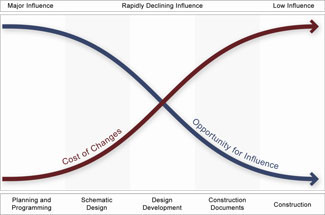
Budget constraints require creative compromises throughout the process. A textbook project will have most decisions set during the programming phase, since changes impact cost and schedule exponentially as the project progresses towards construction. As design develops every aspect of the project develops complex relationships with others parts. A mechanical unit that heats with gas is connected to civil, structural, spatial, and electrical requirements, each of which would be affected significantly if it was changed to an electrical heat unit later on.

Factors that lead to changes later in the project include actual changes of circumstance (e.g. funding) with direct effect on project scope; the common perception that "anything that isn't built yet can be easily changed"; executive levels that have special interest areas in the project, yet were not involved earlier based on time constraints; failure to communicate rationale leading to design compromises; and failure to foresee related changes when discussing "value engineering options".

While it is the architect's responsibility to guide all team members through the process, client awareness of these factors early on can be the ultimate key to a successful project.

Provided by Spark Architecture


It smells... delicious: Applied Phenomenology

Architects study objective and subjective aspects of the built environment. Objective subjects are easily observed and quantified. A bridge structure collapses when subjected to a certain amount of load. Phenomenology is a philosophical approach to more subtle qualities of our surroundings, and has been adopted by architects as a useful framework. It acknowledges that we experience our environment with all senses, and explores conscious and subconscious reactions to various inputs. We may have strong reactions to a place that subconsciously triggers certain associations.

The sense of smell can transport us back to long forgotten memories. It is directly connected with the sense of taste, and it comes to no surprise that it should be of special concern when designing a dining facility.

Fresh bread comes out of the oven at Model Bakery,  Oxbow CA Public Market.

First impressions when approaching the front door of a restaurant are affected by smells reaching from old liquor, burnt fryer oil, chlorine bleach, artificial air freshener, or neutral, to subtle smells of wood, caramelizing onions, baked apple, fresh baked bread, roasted garlic, and fresh croutons  fried in butter.  Careful planning of food preparation locations, as well as air supply and exhaust systems make a big difference. Conscious distribution of "smells" during opening hours such as serving baskets of fresh bread, accompanied by some herbed butter can make all the difference.


Provided by Spark Architecture

Thursday, October 11, 2012

Historic and Economic Development Resources, Great Falls and Montana

We are constantly on the lookout for local, regional, and national resources available to our community. Take a peak at our recent historic building blog post to learn about available resources for community projects. Not all require "historic" status. Please let us know if you know of additional organizations, so we can update the list accordingly.

Thank You!


Historic and Economic Development Resources, Great Falls and Montana

As promised  in our historic tax credit summary,  additional resources are listed below. Please let us know if you are aware of additional resources.

Great Falls Business Improvement (BID) District Grants 


BID grants are available for improvements within the BID district and are funded by a property tax improvement fund (TIF) to support downtown goals. They are unique in that they are available to owners or tenants. Grants cover a percentage of permanent improvements and contract labor costs. Separate grants are available for facade (up to 20%), interiors, and residential (up to 10%). Interiors for new businesses locating within the BID may qualify for up to 30% rebates. These grants are not limited to historic register projects, and may include new construction. Residential projects can be tenant or owner occupied. Property owners must be current on their property taxes to qualify. Recent examples include Taco del Sol, Murphy McClay, subway Building, and Lofts at Johnson Hotel.


Historic Tax Abatement:
The Montana Department of Revenue provides various development incentives, including a provision for development within historic districts. Properties within historic districts can qualify for an abatement of 100% of the taxable value increase attributed to the rehabilitation, restoration, expansion or new construction for a period of up to five years. A recently approved example is the Baum Trinastich Building (a.k.a. Owl Cigar Buidling) at 114 3rd St. S.  For more information contact Great Falls Historic Preservation Officer Ellen Sievert at 455-8435.

Great Falls Development Authority 
Great local business and development organization, supporting small business and attracting large investors. Assistance in finding loans and funding, such as through:

Montana Community Development Corporation
Resource in utilizing "New Market" tax credits for medium to big projects. New construction and existing building projects. 

Tourism Infrastructure Investment Program (TIIP)
The purpose of  (TIIP) is to provide grant funding that leverages other private and public funds for construction of new tourism-related facilities, and the enhancement of existing facilities to encourage visitors to stay in Montana longer and spend more money. The facility construction and enhancement will strengthen Montana’s attraction as a visitor destination. Funding starts at $20,000, with a phenomenal investment ratio of 1:2. Applicant status has to be non-profit. Submission deadline is end of July. Historic value is recognized amongst the selection criteria. In Great Falls restorations and renovation projects such as the Ursuline Center, the Iceplex have been awarded in the past two years. Other statewide projects include museums, parks, pavilions, event centers, and theatre renovations.

National Trust for Preservation
Non profit members of the National Trust Forum or Main Street; Funds have to be matched 1:1, and can generally only be applied to consulting and planning fees, not to construction itself.

Montana Economic Developers Association
Montana wide economic development seminars. Scholarships for industry professional development. 

EPA Brownfield Program

Launched in 1993, the program has provided 2,500 grants totaling $600M in direct funding to turn physical liabilities into community assets to date.  The EPA describes sample brownfields as "an abandoned factory, a boarded up corner gas station, a run down mill. In communities across the country, we see brownfields of every shape and size. It is hard to miss the graffiti-laced walls, the broken windows, the caved in roofs. It is equally hard to dismiss the unknown environmental contaminants and health hazards brownfields can pose." (...)

Community Reinvestment Fund 
Private non-profit organization issuing loans to qualified "socially beneficial" projects.


USDA Rural Development Grants and loans
Funds for rural businesses, communities, planning, local food systems, agriculture, and low income housing repair.

Government Grant search
Searchable database with information about all government grants.


Provided by Spark Architecture

Wednesday, October 10, 2012

Tax credits for historic buidings in Montana

IRS, National Parks, and State Historic Preservation office (SHPO) collaborate in the administration of federal historic tax credits. Current offerings include a federal tax credit of 20%  for non-owner-occupied historic buildings with rehabilitation costs greater $5,000, and a 10 % tax credit for non-residential, and non-historic structures built prior to 1935.

The State of Montana recognizes federal project legibility and currently offers additional 5% for a total of 25% of tax credits. No additional application is required, the state 5% can be directly deducted on state tax returns.

To be considered for the 20% credit, structures should be located in, and contribute to a historic district, which is assessed by the State Historic Preservation office. In addition to urban historic districts, rural districts offer interesting incentives for historic barn renovation for commercial or agricultural use.

If only a portion of the historic building is owner occupied, the remainder may still qualify for the tax credit.

Current Historic districts (HD) in Great Falls, Montana include in order for most recently listed:


  • Great Falls West Bank HD (300 and 400 Blocks, 3rd St NW). Listed 2010
  • Great Falls Central Business HD (Second Ave. N, First Ave. N, Central Ave., First Ave S.). Listed 2004
  • Great Falls Railroad HD ( Park and River Drs., 100-400 blks. 2nd St. S., 100-200 blks 1st and 2nd Aves S., and 100--300 blks. 3rd St. S.) . Listed 1993
  • Great Falls Northside Residential Historic District  (200-900 blocks 4th Ave. N., 100-900 blocks 3rd Ave. N., and 500-900 blocks 2nd Ave. N.). Listed 1991
  • Northern Montana State Fairground Historic District (3rd St NW). Listed 1989

Eligible projects have to comply with national rehabilitation standards and guidelines to preserve essential historic characteristics.


In addition, tax incentives for local development, state funds, and environmentally sound construction, as well as special loan conditions are available. Each of these will be discussed in separate posts.


www.spark-architecture.com

Great Falls Strength and Weaknesses

What are the strengths and weaknesses of Great Falls?

The City of Great Falls, MT  is engaging citizens and groups throughout the community to formulate a new Growth policy "Imagine Great Falls 2025". We attended both the Public Open House and Downtown Chick presentation, and have been following the results with great interest. There still is plenty opportunity to get involved. The summary below highlights a number of recurring themes. The illustrations are word clouds, font size reflects the frequency of certain terms within the published lists. For more detailed information, review the full report on the City website.


Great Falls Strengths:

All groups placed emphasis on River's Edge Trail, which has been developed in based on the previous Growth policy. Besides Recreation, Health care and Schools received positive votes. Events such as Farmers Market and Alive@Five were amongst several  lists. Groups pointed out downtown, symphony, museums, and historical assets, with development potential in tourism and growth. Military is recognized as an asset for the community. Friendliness was a recurring positive characteristic of the community.


Great Falls Needs:

 The section on weaknesses and threats includes a number of wishlist items that are "needed" , or "lack", as well as unpopular aspects of the community. Better Dining and Shopping opportunities, free parking, and alternative transportation, including non-motorized options are amongst the "most wanted" features of the sample groups. Casinos and the appearance of 10th Ave South, are widely criticized. Vacancies downtown and in other areas were associated with a lack of safety and failed development opportunities. Better support for small, diverse, or local businesses is listed repeatedly.


www.spark-architecture.com

The range - sentimental relict, or essential equipment?

Of all commercial kitchen equipment, the gas fired range strikes a tender chord. Our archetypes embrace the image of hearth and fire.  However attached we are to this piece of equipment, it is important to re-analyze its role when planning revisions or new food preparation areas. John Birchfield observes in Design and Layout of Foodservice Facilities that "most food facilities would be better designed if the kitchen did not include open-top or hot-top ranges."

Are you silently screaming "NO"? Exceptions are noted below, but first consider:


Open top ranges have the worst heat to food transfer rate (~90% waste) compared to other cooking equipment. They require more sophisticated exhaust systems, automatic fire suppressant systems, gas lines (if not present), and may cause other more efficient equipment to be underutilized. More efficient commercial cooking equipment includes steamers, steam-jacketed kettles, and convection ovens, which benefit from enclosed heat chambers, facilitating rapid heat transfer, and minimized volume loss. 

Sample griddle/grill

Further, grills or griddles can be efficient alternatives when the equipment is turned off when not used. They are available with smooth and grooved surfaces, and precise temperature control options in 12" increments.


Mechanical system cost for exhaust and general air conditioning load can be dramatically increased by open top ranges. If left "on" when not used exponentially higher operating costs result.  Manufacturers often offer a restaurant line and an institutional/heavy duty line. When foreseeing constant heavy use of the range, restaurant owners should consider specifying "institutional" grade, which offers higher durability and more configuration options.


Exceptions that justify open top ranges are restaurants specializing on sauteed foods and omelets, although many of those could be prepared on a flat grill surface. Small food operations rely on the versatility of a range, which also offers the ability to prepare small orders on demand. A range can encourage Chef's to engage in additional experimental research and menu development. Further, new concepts of "show kitchens", with glazing proudly displaying the inner workings of a commercial kitchens, may be able to befit from the visual merchandising effect range cooking offers. A successful example for this concept is Liberty Market in Gilbert, AZ.